Skip to content


Most people first hear about microneedling through its results: smoother texture, softer lines, and less noticeable scarring. The more useful question is what actually produces those changes, because the answer explains why the treatment works gradually and why a series is usually recommended. At KOR Medspa in Reading, PA, this is one of the questions clients ask most often before their first session.
In short, SkinPen microneedling doesn’t resurface your skin from the outside. It prompts your skin to rebuild itself from within, using a repair process your body already knows how to run.
How does microneedling renew the skin from the inside?
SkinPen creates precise micro-channels in the skin that trigger the body’s natural repair response, which produces fresh collagen and elastin in the weeks that follow. Visible improvement comes from that newly built tissue rather than anything applied to the surface.
Collagen Induction Therapy, Explained in Plain Language
Collagen induction therapy is the clinical name for microneedling, and it’s a fairly literal description of the mechanism. To induce something is to prompt it, and this treatment prompts your own collagen production. Collagen is the structural protein that keeps skin firm and supported. Elastin is the companion protein that lets skin stretch and return to shape.
Both decline steadily with age, and sun exposure accelerates that decline considerably. Here is the distinction worth holding onto as you read the rest, nothing is deposited into the skin during this treatment- no filler, no product, no volume. Every improvement traces back to tissue your body manufactured itself.
How the SkinPen Device Starts the Process
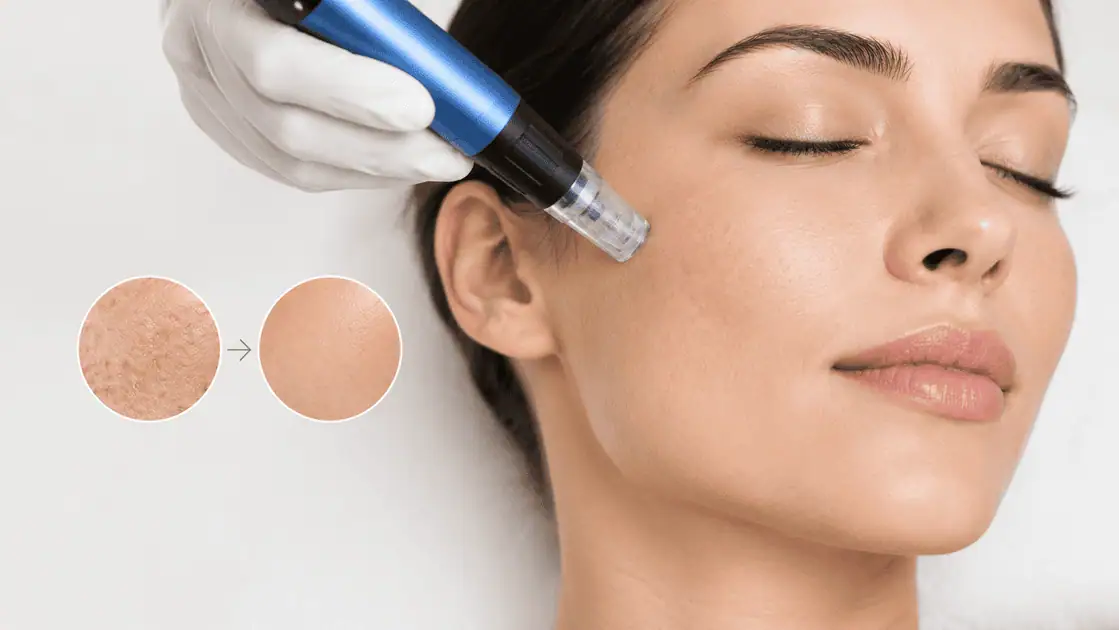
SkinPen® is a medical-grade device with a sterile, single-use needle cartridge that moves in a controlled vertical motion at a set speed and depth. That vertical movement creates clean micro-channels rather than dragging across the surface. Those channels are precise and shallow enough that the outer layer closes quickly, which is why providers describe this as a controlled injury rather than a wound.
The stimulus is real enough to activate repair, and contained enough that the skin barrier recovers within hours. Depth is a clinical judgment, not a fixed setting. The forehead, the cheeks, and the delicate skin beneath the eyes each call for different depths. SkinPen® Precision is FDA-cleared to treat facial acne scars in patients 22 and older, and separately to improve the appearance of neck wrinkles in adults 22 and older.
What Happens Beneath the Surface Once Treatment Ends
The interesting part begins after you leave the treatment room. Your skin moves through three overlapping healing phases.
- Inflammation. In the first hours, the body signals that repair is needed and directs growth factors to the treated area. The mild flush most clients notice is this phase in progress.
- Proliferation. Over the following days, fibroblasts activate and begin producing new collagen and elastin fibers to fill and support the treated tissue.
- Remodeling. Across the following weeks, that early, loosely organized collagen reorganizes into stronger, better-aligned tissue.
That final phase is where skin texture renewal actually happens. The skin is not being sanded down or peeled away. It rebuilds underneath, and the surface change follows the structural change.
How New Collagen and Elastin Change the Way Skin Looks
Denser collagen means better structural support, and better support is what makes fine lines look softer and skin feel more resilient to the touch. The line has not been erased. The tissue holding it has been reinforced.
The same principle applies to pores. When collagen around a pore opening thickens, the opening tends to look less pronounced. With acne scarring, remodeled tissue can gradually soften the depressed edges of a scar, which is why acne scar improvement often shows up as smoother texture before it shows up as more even tone. Most clients see gradual, cumulative change rather than a single dramatic shift, and results vary based on skin type, age, the concern being treated, and how consistently the skin is protected afterward.
Why Renewal Takes Weeks Instead of Days
Collagen synthesis runs on a biological timeline that no device can shorten. Fibroblasts produce new fibers at their own pace, and remodeling continues well after the redness has faded.
A single session commonly takes about a month to show its full effect, which lines up neatly with the remodeling phase. Sessions are typically spaced around four weeks apart for that reason, and each round begins a new repair cycle on tissue that has already been partly rebuilt. For general rejuvenation, four to five sessions are often recommended, while scarring usually calls for six to eight.
Which Skin Concerns Respond to Collagen Induction
Collagen induction tends to respond well for fine lines, uneven texture, enlarged-looking pores, acne scarring, and mild skin laxity. These concerns share a common cause: a thinning or disorganized collagen layer.
It responds less predictably, or not at all, for active acne breakouts, deep static folds that reflect volume loss rather than surface change, and pigment concerns driven by hormones such as melasma. Naming those limits honestly is part of good candidacy assessment. Skin tone is not the barrier here that it can be with some energy-based treatments. However, a provider still evaluates candidacy individually by reviewing your history, medications, and current skin condition.
What Supports the Skin While It Rebuilds
Sun protection does the most work after treatment because ultraviolet exposure degrades the exact collagen your skin just worked to produce. Daily broad-spectrum SPF protects the investment.
Keep skincare simple and barrier-supporting during the first several days, and hold off on retinoids, acids, and other actives until your provider clears them. Mild redness and swelling for a few hours is normal, and you should generally avoid intense exercise for about 24 hours. Downtime is minimal, though it is not nonexistent.
Talk Through Collagen Induction With Our Team
The right depth, spacing, and number of sessions depends entirely on the skin being treated, which is why a consultation comes before a plan. If you are considering SkinPen microneedling Reading PA clients trust for gradual, structural improvement, our team at KOR Medspa can walk you through what your skin realistically needs and what to expect at each stage. Book Your SkinPen Session